Observation

Spy-cam wildlife filmmaking

Spy-cam wildlife filmmaking is an interesting discipline. It builds upon the decades of innovation that the documentary film genre has built upon. From the earliest images by the Lumière brothers of the workers at a factory to the development of film editing by Eisenstein and Dziva Vertov demonstrated by “The Man With the Movie Camera to sync sound with the Crystal sound system used by Jean Rouch for Chronique d’un été. The BBC is seen as the leading example of high quality television programming and this has been the case for decades. The Natural History Unit is responsible for some of the best wildlife documentary films and series and with good reason. They adopt the latest technology, hire crews for months or even years at a time, to capture nature’s spectacle and beauty, and bring it to living rooms around the world. Sensory: BBC Wildlife Director John Downer & the technology of ‘spy-cam’ filmmaking from Getty Images on Vimeo. This attention to detail and this dedication to getting the best images has resulted in some of the best looking documentaries around. the Blue Planet Series, the Planet Earth series, Life and others have provided people with what I like to call a video encyclopaedia of the natural world. The technological innovation that we see in the video above demonstrates how animals and behaviour that we had seen through a tele-lens can now be seen up close and with as natural a behaviour as possible. Almost every book I have read about the documentary genre speaks about capturing life with as little alteration of natural behaviour as possible. This technology is making that wish a more realistic goal.
Getting an audience to film screenings

Adam Aron, CEO of AMC recently made a generation of cinema non-goers angry with him when he said that he would allow texting to take place during projects. My generation, previous generations and the generations of the future complained on social media. Getting an audience to film screenings requires an understanding of what they prefer to do instead. In the “Golden Age” of my cinema going life I would go to the cinema up to three times a week. I went this frequently because I lived close to the cinema, because we had two GBP Tuesdays and because it was something to do when other people were not available. Over a period of months I went to see more than 90 films. A consequence of this habit was over-familiarity with the codes and conventions of mainstream cinema. Since that “golden age” I have seldom been back to the cinema. When you know everything that will happen in a film within the first 15 minutes you get bored. I know AMC through its television Series of which the Walking Dead is one. This is a series that I did binge watch when it was fresh and again when it was made available via netflix. Television series have better writers and better storylines than films. They also don’t overdo it with super hero rubbish and special effects. As these productions have storylines we care enough to watch one episode after another. Films fail to engage us in this manner. When I was in London I went to a few screenings. The screenings I usually went to in London were at the Front Line Club. You would watch a documentary about current affairs and there would be a panel to discussion to discuss what you had just seen. In Geneva I found that the graduate Institute has started to do the same thing. I regularly go to such events because I like to complement what I already know by watching interesting productions and then listening to questions and answers sessions and learning something new. Montagne en Scène is an example of what AMC should think of doing. They need to find and fund the production of films for niche markets. Montagne en Scène is an event where four mountain related films are projected to a specialist audience of mountain and sports enthusiasts. This niche usually relies on youtube and vimeo to find and share footage of their passions. By organising a special day these enthusiasts are encouraged to come to film screenings. AMC is competing against mobile phones, televisions, Virtual reality goggles, tablets and Video on Demand via the World Wide Web. what they need to do is lower the price and make it more convenient for people in contemporary culture. Having panel discussions at the end of a screening is one way of attracting people. Lowering the ticket price would be another way. If they stopped making CGI films with no story then I would start going to the cinema again. This complain extends to the crappy films currently available, at least in Switzerland on Netflix. If Netflix did not have television series I would have stopped paying for their service months ago. If you treat your customers/viewers like mature adults then there is a good chance that you will attract them to film screenings on a more regular basis.

Cycling in Winter

After cycling over 1100 kilometres in 2015, I aim to cycle 1200 kilometres in 2016. This goal is an easy one to achieve. It’s the 21st of January and I already have 100 kilometres logged. The weather over the last three weeks has been cold and wet. We have had rain almost every day and it recently turned to snow. As there is a lack of good weather there is no choice but to go out in the bad weather. Cycling in these conditions is messy. Your clothes get soaked from the rain and as I cycle in the countryside I come home covered in mud. When I get home I change into dry clothes and I recover quickly. Rain is easy to deal with once you’re ready to feel wet and dress for the cold. What is more challenging is cycling on slick tires on snow. Some of the roads I cycle on are salted and cleared but as I also use agricultural roads they are covered in snow. Safety takes focus and concentration. The rear wheel skids if you apply too much force to the pedal and the bike can skew if you are not careful. Cycling in such conditions is not ideal. It demands resistance to the cold, stamina to continue making the effort and determination to set an achievable goal. I will continue towards 200 kilometres by the end of February. Cycling consistently now will make summer all the more pleasant and rewarding.

Day In Auschwitz

“If you were young and healthy and if they needed labour then you were selected as slave labour. You would have suffered a slow death rather than a fast one”. This soundbite is 13 minutes in. In this documentary a concentration camp survivor takes two girls who are the age she was when she arrived through the camp and tells them about her experiences. We owe it to future generations to keep re-sharing these accounts and documentaries to prevent such actions from ever happening again. I have just finished watching the documentary and I feel almost shell shocked. I have been to the camp and I have read about the topic. I have also watched a number of topics on this topic. What makes this the most poignant documentary is that this woman, this grandmother of eight is making sure that future generations are aware of what Auschwitz life was like. She tells us about survival.

Netflix provides a better opportunity for documentary content distribution than Discovery

In the 1990s when satellite distribution of television content was in it’s infancy we got a satellite dish and I would watch the Discovery Channel from the start of the broadcast day to when the programmes were played for the second time that day. By watching so many documentaries I learned a lot about the world. I watched Mythbusters, Lonely Planet, Modern Marvels and many many other documentaries. It is only ten years later that I stopped watching Discovery. By that time I was no longer in the family home and so documentary viewing was more restrictive. Whilst at the University of Bournemouth and the University of Westminster I did take advantage to watch as many documentaries as I could find. The dissertation I wrote during my third year of studies was about the documentary genre. I had an academic reason to watch these documentaries. It was no longer a hobby. Aside from the selection of Discovery channels and University VHS tapes documentaries can also be found on national and European channels. I am thinking of Temps Present, Passe Moi Les Jumelles and other factual programmes and current affairs content. These documentaries fit within a specific format to be broadcast at the same times every week. We then have artistic documentaries like those broadcast on Arte, shown at independent cinemas, festivals and more. These documentaries are not adapted for mainstream viewing. They fill a niche. They are sometimes hard to watch and other times so niche that aside from those with that passion or interest no one will ever watch them. The Discovery Channel network broadcasts set documentaries at set times on set channels for a set number of hours per day. Viewers can either watch documentaries as they are broadcast or on demand. As PVR arrived viewers could shape their viewing habits around their lifestyle rather than the other way around. Discovery channel documentaries have two serious flaws, that as a documentary professional cannot stand. The first of these is commercial breaks. When I watch content I want to watch it from start to finish. I don’t want it to be interrupted because it means that for two or three minutes I have to find something else to do. This could be a serious trigger to people having a laptop or tablet with them when watching TV. The second very big flaw with Discovery TV documentaries is sensationalism and repetition. I found that when watching hour long documentaries on Discovery television channels more than half of the time is spent repeating what has happened and what will happen with very little content left over. You will spend an hour watching a show that could have been over in just 24 minutes. This is an excellent way to lose viewers. Netflix is a video on demand platform. This platform makes available all of the content it has licensed to it’s customers. This content is ready to play within seconds and has no adverts. This is great for content creators. It means that they can spend more time moving the story forward. There is no need to worry about viewers starting to watch a show half way through. It means that if you have a 42 minute slot you can spend 52 minutes telling the story. This is great for content creators. The flaw of Discovery Channel documentaries and commercial television in general is that they make mediocre content and then add adverts every few minutes. This means that a mediocre programme will be watched from one commercial to another before the channel is changed. They live under the misconception that sensationalism and excited narration will keep viewers. It has the opposite effect, at least on me. Netflix allows you to watch the BBC Blue Planet and Planet Earth documentaries with no adverts. This gives documentary makers an advantage. Imagine watching Planet Earth documentary episodes that are 52 minutes long with an extra 15 minutes or more of adverts thrown in. For this reason Netflix is an excellent documentary distribution platform.

On the lack of Common interests and mobile phones getting the blame

On Linkedin and Facebook people believe that mobile phones are making people less sociable then they would be if phones were not around. They believe that the world in which we lived before mobile phones was an open and sociable place where everyone communicated with everyone. These people are forgetting the social context that brought them Home Alone, Problem Child and other films. Society and social interactions have always been about finding the people whom you appreciate and those whom you prefer to keep away from. In the age before mobile phones I remember watching films and cartoons where certain characters were ostracised for being different. These people were seen as isolated or loners. Society does not like these people. We see it conversation and we see it in films. If a group of people in the physical world does not want to spend time with you, does not want to listen to you because your passions are incompatible with theirs, because your tone of voice is not right then that is their right. These people though, are not satisfied with excluding you from their conversations, are not satisfied with having their monologues and showing no interest in you. They will go a step further. They will prevent you from entertaining yourself. One of the most common forms of entertainment when people are not fully engaged with groups is the mobile phone. Mobile phone use is stigmatised by a lot of people. Just a few weeks ago I took a chance and met with a new group. As I am an ingress player and as I had nothing positive to add to the conversation I took the opportunity to farm from two portals that were in range. As I live in the countryside Ingress “farming” is a treat and I took advantage of the opportunity. I was listening to the conversations taking place on both sides of me. On one side it was the stereotypical “What do you do?” International community conversation and on the other they were discussing a few topics. One of these topics was music festivals. I have had a lot of fun at music festivals but I also have some views that I share with facebook friends rather than the wider world as it would see me ostracised. As I drove home from the meeting above I got a text message and felt that it would be bad. I read it when I got home and left the group. I won’t be told how to behave by strangers. I won’t be judged in a town by a group of people who hike and do via ferrata. If you participate in both of these sports there is a good chance that you will appreciate my company. When I am in the mountains one of the cameras I carry around is out but my mobile phone is in a pocket until I get to the end of the activity or the car. I am a member of the Geneva Ingress Resistance as well as the Lausanne Ingress resistance. As a result of this I have access via Google Hangouts to at least 120 people in the Lac Léman (lake Geneva) region. These people are unique. What makes them stand out is that they’re always looking at their mobile phones and when you see the entire group is silent it’s because they’re “glyphing”. I like to spend time with these groups because we eat crisps, drink wine, eat ice creams, hike and do other activities. These people meet because of the game but you see that there are deep friendships that have benefited from mobile phone use. I love the paradox. The paradox is as follows. Every user is in the Google Plus community, every user converses with other players in Google Hangouts and every player meets other players in the real world. The mobile phone is a link between those who are not present and those who are present. In effect whether you converse with these people from a computer, by mobile phone or in person changes little. Last week at the end of one operation to field over Yverdon with blue fields and another operation to field another city a phone call was made via google hangouts and we all answered and put the phones to our heads for a conference call. Instead of the mobile phone isolating people it is doing the opposite. It is uniting people. Look at the conventional social interaction. When two normal people call each other the people you’re with are isolated for a period of time. It’s the same when people in face to face conversations start talking about mutual friends, certain types of activities and more. Sometimes the conversation that two conventional people are having is more likely to isolate the people you’re in the same physical location with. More often than not small talk is frustrating because A) you don’t know whom they’re talking about and B) you don’t know the context. As a result small talk is less polite than mobile phone use. I love the mountains and I enjoy via ferrata and hiking when it’s with the right people. I also enjoy spending time with ingress players. With these three groups of people I feel that I can be myself. I spend no time acting and performing. They appreciate the real me.  When I go to towns and listen to normal people small talk I get bored and I feel isolated. It has nothing to do with the mobile phone and everything to do with the difference in interests and passions. If we don’t have the same interests and passions then don’t blame mobile phones for our lack of conversation. Either we find something we are both passionate about or we co-exist in the same space without talking much… Sometimes the inability for people to accept silence when they are not alone encourages others to be alone.

Social conversations and the social media

If you read “How to Win Friends and Influence People” you see how important it is to take notice of other people, to be positive and to be interested in what they are doing. That can be a challenge for everyone. We all have different priorities so putting other people first is a challenge. The World Wide Web is a place where we can listen and talk at the same time. We listen to a conversation and then we comment. We can start our own conversation and wait for others to see it and respond. As a result we are both engaging with others and letting others engage with us. There is a bilateral trade which leaves both parties feeling good. Social media, today a misnomer, was a conversation place. Everyone talked with everyone and everyone became familiar with everyone else. The Global Village that Marshall McLuhan wrote about looked like it would become a reality. At the time when this reality looked the most feasible was the time before mobile phones and proper data plans. At this time we used computers from a fixed location, either at home, an office, university or other places. With Wifi we had some freedom but nowhere the freedom that smart phones and data plans have provided us with. That’s why people’s feeling that mobile phones are disconnecting people is such a ridiculous notion. In my vision of the world, in the adoption cycle that I observe the mobile phone is the great connector. We meet people online, we appreciate them, we meet them in person. Seesmic and the early days of twitter were very good tools for this lifestyle. As data plans included more and more data so it would follow that social media websites would be about individual to individual conversation. It would logically follow that people would feel more at ease conversing online as their friends adopt the technology and have chats. Facebook, twitter and Google Plus should be social web forums where people are interested in the people they follow. What I see, as data plans and smartphone adoption rises is the opposite. People share links and promote rather than converse. Social media should be rebranded as Ego Media, brand media or advertising media. The platforms that should have made us conversational have been overtaken by advertising. It’s a good time to continue blogging. It’s a monologue until you contribute a comment. The World Wide Web is a de-centralised conversation tool and we move from platform to platform looking for the places where the personal connections are strongest. As the social media days fade in to history now is the time for each of us to blog, to write about what we feel passionate about.

The Crosscall Odyssey Plus

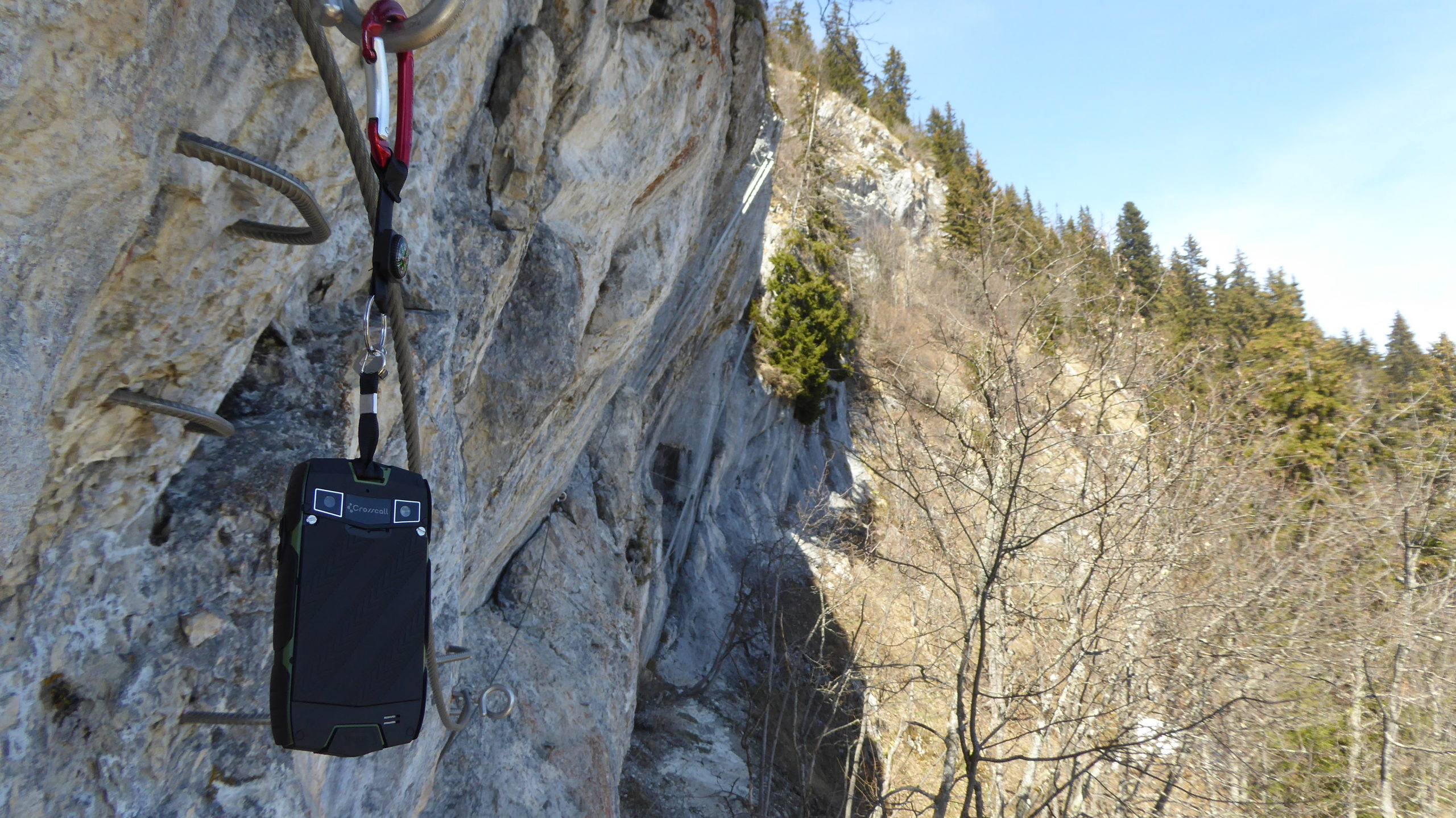
  The Crosscall Odyssey Plus fills two niches. It is a rugged weather proof phone rated to the IP 68 standard and is equipped with dual sim capability. This makes it ideal for the sports I enjoy, mainly via ferrata as pictured below and hiking. It comes with a smaller carabiner than the one pictured below. I swapped it for one of my own. 1030283 IP 68 is a code to determine how resistant a device is to both particulate matter and liquids. 6 denotes that the device is dust tight so particulate matter will not make it’s way in. 8 as defined by the manufacturer denotes that this device can be submerged for half an hour at 1m before damage occurs. If you get caught in the rain or have to cross a river the phone should survive. Another interesting feature is the dual sim capability. This phone allows for two microsims to be used at once. In my case I have a Swiss sim card and a french one. Both sims are constantly active so you can select whether to make phone calls from Sim 1 or Sim 2. You can also select which sim card is using the data plan. It runs android 4.3 and works fine with the TomTom app, the ingress and others. I found that battery life is also comfortable. With me as a user the battery lasts for a day. more info

Access to contemporary technology helped promote my habits as an early adopter.

Parents in the silly con valley are idiots. They are in a trillion dollar industry and make billions a year because people want to use the technology they are developing. Think about how different my childhood would have been if we had learned camera work and video editing in art classes rather than painting, pottery and other less interesting art forms. Imagine if as a child I had not watched Cousteau Documentaries. Two of my strongest passions would never have emerged… scuba diving and documentary making. The luddites who amass personal wealth worth billions should understand that new technologies promote creativity and innovation rather than the opposite. Look at games and how they have evolved. Look at the emergence of multiplayer gaming right up to the leading edge games like Ingress among others. Without creativity and free time with new technologies revenue would be less forthcoming. My passions for video and editing were held up for many years because I had no access to an edit suite. Imagine how the children of Sillicon Valley execs are having their creativity stunted because of the very people who have most to gain from their children being early rather than late adopters. “Those who endorse this approach say computers inhibit creative thinking, movement, human interaction and attention spans.” These people demonstrate just how limited their understanding of modern technology is. News organisations are teaching their staff how to shoot and edit news stories using mobile phones, others are using tablets to write books and more. The idea that information technology prevents people from moving around in today’s world is redundant. How many of you still have a desktop at home that you use regularly. I personally use my mobile phone and a laptop most of the time. The laptop is with me everywhere I go. As a child and as a professional the thing that limited my movement is classroom and office time. In the classroom you learn at the speed the teacher chooses. There is no fast forwarding, skimming or rewinding. Everyone learns the same information at the same speed… in theory. In practice we learn at different speeds and information technology allows us to build knowledge actively. As children we had books and we learned by reading different chapters at different moments. Imagine studying the Roman civilisation as a child and wanting to see pictures and video from the time. Multimedia devices and computers would bring more to life quicker. I strongly believe that children should be given the freedom to use the technology or medium they want to use. It is not up to adults to decide which tools are relevant to their children. As an early adopter contemporary values and norms have held me back and stop others from keeping up.

The Rescued Film Project

Undeveloped World War II Film Discovered from The Rescued Film Project on Vimeo.

We all have a deep fascination for the past and photography gives us a window in to that past. This documentary follows one individual as he catalogues and then develops 31 rolls of film. As he does so images and moments that have not been remembered for decades are finally visible for a modern audience. These images contribute to what Dziga Vertov called the All Seeing Eye. He wanted to document life unawares.